2>3: Applications of the Midrange Shot
Completed as part of MAST 397 - Special Topics in Math & Stats: Sports Analytics - Joshua Wyatt Smith
GithubIntroduction
In the modern-day NBA three point shots are the poster child of analytics. Teams like the Golden State Warriors have utilized offenses which attempt high numbers of 3's to achieve success in the regular and postseason. The trend has caught on league wide. Spurred by the chant “3 > 2” teams now jack up more 3's than ever and try their other shots as close to the goal as possible. This change was spurred by simple statistics: why take a shot from 20 ft. when you can step back to 24 ft.. Both these shots have similar chances of going in, so the math tells you to give yourself the chance at that extra point by shooting from behind the 3P line. This is a beautiful application of math in sports, but nothing is gained without losing something else. In the case of the three pointer revolution, what was lost was the mid range shot. My project will be aimed at determining what the value of a mid range shot is in today's post-three-point-revolution NBA.
Literature Review
The mid range shot did not die slowly, and the three point revolution did not happen overnight. However, the point remains: the 2017-18 Houston Rockets became the first team in NBA history to shoot more 3's than 2's (3470 and 3436 respectively) (Freitas). That inequality was not reached spontaneously. In fact “the only statistically significant change between two consecutive seasons in the statistics analyzed” by Freitas “was the 3PTA for seasons 1985-86 (0.76 to 1.05, adjusted p=0.0732)” (Freitas). That specific jump happened in the early childhood of the three point line. The upward trench was a “result of a gradual increase in 3PTA throughout the seasons” (Freitas). Freitas takes an objective observer role, whereas Partnow seems to have some dog in the fight over the soul of basketball. Partnow claims that “it was a stroke of luck for basketball as a spectator sport that the three-point line was invented prior to the ability to track and record shot locations. The game could have easily become borderline unwatchable with the order reversed” (Partnow 116). This is where my personal biases come out. My fear is that as the mid range shot dies it will take basketball with it; basketball could become overly afflicted by three-true-outcome strategies like baseball. Thankfully basketball has a little more nuance. Not to say that is better, “well-designed games or sports allow for multiple plausible avenues that give reasonable chances of success. This is not that” (Partnow 117). My (possibly, plausible, probably) irrational fear is that in basketball the only avenues to success will be shooting 3's and taking layups. That being said, “the shifting of shots from other spots to three-point range does not mean the NBA has become a jump shooting league. At least it hasn't become more of one than it already was” (Partnow 120). So hopefully the soul of basketball is safe. One incredibly interesting thing Partnow found was that “it was almost exclusively assisted midrange shot attempts that had been subbed out” for three-pointers (Partnow 128). That observation is exactly the kind of red flag that I am determined to investigate, and other flags like it will guide my study.
Data
I will be using that data from https://github.com/wyatt-ai/nba-movement-data which is a helpful adaptation of the original repository: https://github.com/sealneaward/nba-movement-data (thanks to our intrepid professor for the help). The repository consists of event and tracking data for NBA games from the 2015-16 season, provided by SportVU. I will not be able to examine every game because of computational limitations (ie my computer doesn't have space for every game from that season on it), but I am extremely excited to launch into the data nonetheless.
Methodology
I want to examine a couple things that may not have been taken into account when mid-ranges were eliminated from basketball. I will examine how shots affect opposing defensive arrangements as games progress, and hopefully find which situations a mid range shot is advisable under. I expect that these goals will lead down some rabbit holes. However, I would love to take the time to look at some simpler measurable quantities: like expected points on a possession following different shot types.
Another place where I will examine the impact of mid range shots is the psychological impact they have on defenses. However, I cannot look inside the heads of players while I sit here X years in the future. To try and approximate this impact will be crucial to project as it incorporates many of the elements I wished to look at above. While this is difficult, keeping it in mind will guide my study in more productive directions than wildly jumping into the data and attempting a regression on everything in sight. Encoding domain knowledge into methodology is crucial for studies that examine the nitty-gritty details of a game.
My goal is a lofty one, and even I am not sure there is sufficient evidence to get me to where I need to go. The upshot: I am trying to find situations where 2 > 3. Even if I cannot find a niche that the mid range shot fills, I will have performed in-depth analysis on a topical subject from an unorthodox angle.
Limitations
The data that I was working with presented a major limitation to research potential. The fact that the data is a copy of the original data, which has been taken away from the public domain, is likely the culprit. The result is inconsistent data that must be massaged in order to be effectively utilized. Specifically, the shot logs which I was so interested in contain duplicate values. This is not just an effect of normalizing the data ( i.e. this problem extends to the raw data as well). I was excited to look at sequences of teams' shots, and because of the nature of the study I undertook this limitation had an outsized effect
Data Fixing
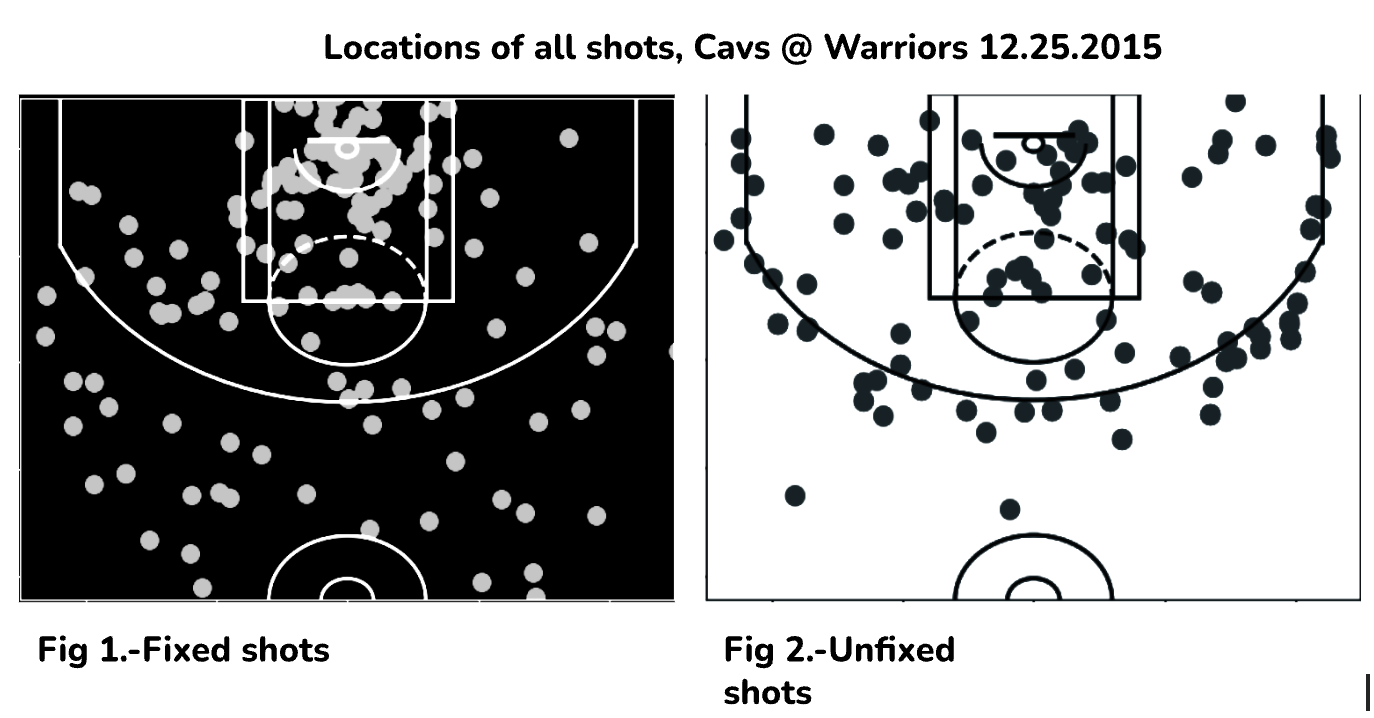
To deal with the limitations of the data there were two options: manually fix values that I could or fix them using some sort of determined method. It was possible to manually fix shot times by tracking the distance between the ball and the shooter (after that other necessary information could be extracted as well, e.g. shot location), but was a time consuming process and not viable for extended study. The algorithm I was forced to use was fixing shot times and other variables based on the time the scoreboard was showing at the time of the shot: finding the closest corresponding time to two decimal places in the tracking data and taking that as shot time. The effect, as can be visualized below, was substantial, but not completely inhibiting. The repository comes with a method to find shot times, which I considered re-writing, and there are certainly others. While the specifics of this sort of data science are incredibly intriguing, they are outside the scope of this project and will necessarily remain something for me to consider examining independently.
Results + Justification
Midrange shots don't present themselves favorably to modern analytics. The argument that they provide diminished returns on a per-shot basis cannot be disproven. However they represent a crucial element in the foundation of basketball: a building block. When James Naismith put up a peach basket, he didn't paint a three point line; there was no reason to shoot from farther than you had to. But eventually the jump shot evolved, and it represented another threat that defenses had to defend. Jump shots never go in more than layups. They provide their value by making defenders respect that tendency on following possessions. The addition of the three point line to this changes the geometry of the court. Now it seems reasonable to just take your jump shots from behind the line to cash in on the bonus point. But it is possible to take away both the post and limit 3's as we've seen with the drop coverages, and as the league gets more athletic that could get even more prevalent. When teams are able to do that, the midrange is another tendency you can show and make them respect. Over the three games that I analyzed in my study the results support this conclusion. Teams got better looks and knocked them down more efficiently when the previous shot was from the midrange. Effectively I have found the niche where midrange shots provide value that is not obvious from usual methods.
Next Shot Statistics
Especially in the modern NBA that heaps emphasis on 3-pt shooting, the results are encouraging for the state of midrange shooting. If these results hold on a larger scale then midrange shots could be presented as a way to engineer better shots for NBA teams. These results are not a prescription. Optimizing shot selection on sequences of possessions is even more impractical than doing so on a per-shot basis.
Future Study
The next focus of my study will be attempting to build a model that captures the gravity that players have. This is a recent phenomenon in the NBA, and I was able to observe it first hand during this project. (fig. 4). My current idea is to treat the game like a 10-body problem and attempt to model it utilizing data driven methods for dynamical systems.
Works Cited
Freitas, Lucas. “Shot Distribution in the NBA: Did We See When 3-Point Shots Became Popular?” German Journal of Exercise and Sport Research, Springer Berlin Heidelberg, 2021, www.ncbi.nlm.nih.gov/pmc/articles/PMC7712598/.
Partnow, Seth. The Midrange Theory: Basketball's Evolution in the Age of Analytics. Triumph Books LLC, 2022.